


The history of CPR took a groundbreaking turn in 1960 when Drs. Jude, Safar, and Kouwenhoven created a method combining chest compressions with rescue breaths. This technique worked much better than past resuscitation methods. It set a new standard in emergency care. In 1963, the American Heart Association said CPR can save lives during cardiac arrest. This confirmed its importance in modern medicine. This key development changed emergency response. It’s still a basic practice that saves lives today.
CPR is a life-saving method. It helps restore breathing and circulation during emergencies, like cardiac arrest. The modern approach has been used for over 50 years. But manually stimulating the heart and lungs goes back centuries. CPR has changed a lot. It started as basic resuscitation but now is a key part of emergency care.
What are the origins of artificial respiration and CPR techniques?
Artificial respiration began in ancient Greece and Rome. Early doctors tried different ways to help drowning victims. In the first century A.D., the Greek doctor Galen described a method. He used a reed to send air into the lungs. Roman doctors later refined these efforts by applying abdominal pressure to enhance airflow. These early experiments set the foundation for the advanced resuscitation techniques used today.
Over the years, inventors created many methods for artificial respiration. Some used bellows, while others involved manual chest pressure. Many attempts at innovation were unsuccessful. As a result, survival rates for cardiac arrest or respiratory failure stayed low.
Get certified in CPR
CPR & AED Training
3-hour in-person training with a 2-year nationally recognized certification.
CPR, AED & First Aid Certification
Instructor-led on-site. Practice on real manikins and AED trainers.
Early Years of CPR
In 1740, the Paris Academy of Sciences supported mouth-to-mouth resuscitation for drowning victims. This was an early step in life-saving techniques. Yet, it wasn’t until the 19th century that CPR saw a documented success. Dr. Friedrich Maass saved a patient from a drug overdose with chest compressions. This moment was a key breakthrough in the history of resuscitation.
Following this breakthrough, researchers sought to develop CPR techniques for broader use. In 1903, Dr. George Crile showed that chest compressions could restart circulation. He proved this by experimenting on dogs. His findings reinforced the potential of CPR as a lifesaving method.
In the 1920s, Dr. Charles L. Beck created the Holger-Nielsen method. This method used chest compressions and a rubber bulb to push air into the lungs. This method became popular during World War II. By the 1940s, it was the standard CPR technique.
The Holger-Nielsen method is popular, but it has big problems. It needs two people and often doesn’t bring patients back to life. Its limits drove researchers to create better CPR methods. These aim to boost survival rates.
Modern CPR
In 1960, Dr. James Jude, Dr. Peter Safar, and Dr William Kouwenhoven developed the first modern CPR method by combining chest compressions with artificial respiration. Their innovation laid the foundation for the life-saving technique used today.
CPR changed emergency medicine. It gave responders the first real way to help during cardiac arrest. Before its development, survival rates were under 10%. There was no reliable way to revive patients.
CPR has greatly improved survival rates for cardiac arrest victims. The American Heart Association says that around 45% of people who get immediate CPR outside a hospital survive.
Who were the pioneers of modern CPR, and how did they develop the technique?
In 1960, Drs. James Jude, Peter Safar, and William Kouwenhoven changed emergency medicine. They created modern CPR. They combined chest compressions with rescue breaths in a life-saving technique. This approach is key to treating cardiac arrest and respiratory failure.
Dr. Jude found that chest compressions alone couldn’t bring back circulation and breathing. This led him to explore combining compressions with artificial respiration. After years of research, he created a method. This technique brought patients back from cardiac arrest or respiratory failure.
Dr. Safar developed the first CPR algorithms, simplifying the process for emergency responders. Dr. Kouwenhoven enhanced CPR with closed-chest cardiac massage. This method worked better than the old open-chest techniques.
These pioneers revolutionized emergency medicine, establishing CPR as an essential life-saving technique.
What was the survival rate for cardiac arrest before modern CPR?
Before CPR, survival rates for sudden cardiac arrest were under 10%. Its introduction led to significant improvements in outcomes. The American Heart Association states that about 45% of patients survive when CPR begins right away outside a hospital.
RECOMMENDED
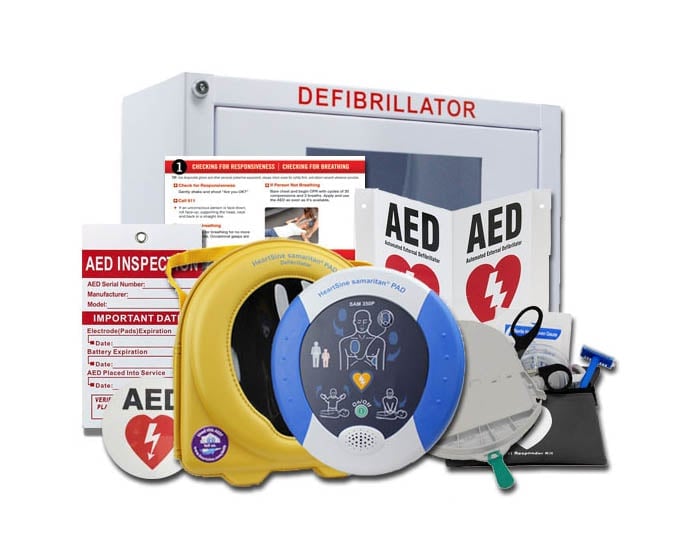
HeartSine Samaritan 350P AED Package
Compact, fully-automatic AED designed for first-time responders. Pads, battery, carry case and wall sign included.
Promotion of CPR Training
In 1972, the American Heart Association started the first CPR course for healthcare workers. It mixed classroom lessons with hands-on training. In that same year, Leonard Cobb started Medic II. It was the first major CPR training program for the public in the U.S.
In the 1980s, the American Heart Association launched a campaign. They aimed to promote CPR training. They highlighted how CPR can save lives. The “Friends and Family” initiative taught people CPR. This way, they could help their loved ones in emergencies.
The Impact of CPR
CPR has transformed emergency medicine, significantly increasing survival rates for cardiac arrest victims. It works well for drowning, drug overdoses, and other medical emergencies. This makes it an important life-saving technique.
CPR has not only saved lives but has also shaped public health education. In many places, like the U.S., healthcare workers and emergency responders must get certified. Schools and community groups have boosted CPR training. This has raised awareness and improved readiness for medical emergencies.
CPR History Timeline: The Development of Cardiopulmonary Resuscitation
1700s
1740: The French Academy of Sciences in Paris recommended mouth-to-mouth resuscitation for drowning victims.
1767: The Society for the Recovery of Drowned Persons was the first group to deal with sudden deaths.
1800s
1891: Dr. Friedrich Maass performed the first equivocally documented chest compression in humans.
1900s
1903: Dr. George Crile reported the first success in using external chest compressions to resurrect a human.
1904: Dr. George Crile performed the first American case of closed-chest cardiac massage.
1954: James Elam was the first to prove that expired air was enough to maintain oxygen levels.
When was CPR invented?
1956: Peter Safar and James Elam invented mouth-to-mouth resuscitation.
1957: The U.S. military adopted mouth-to-mouth resuscitation to revive unresponsive victims.
1960: Cardiopulmonary resuscitation (CPR) was developed. The American Heart Association started a program to teach doctors about closed-chest CPR. It was the first to train the public in CPR.
1963: cardiologist Leonard Scherlis founded the AHA’s CPR Committee. It endorsed CPR as a lifesaving technique that year.
1966: The National Research Council held a special conference on CPR in response to requests from the American Red Cross and others. This gathering aimed to create standardized CPR training and performance guidelines.
1972: Leonard Cobb held the world’s first mass CPR training, called Medic 2, in Seattle. He helped train over 100,000 people in the program’s first two years.
2000s
2003: ProCPR launched an online CPR course for the first time.
2008: Hands-only CPR (or Compression-Only CPR) is introduced. It encourages bystanders to provide compressions if they witness an arrest. The goal is to get people involved.
2014: ProTrainings launches SUMO – a Single-Use Manikin Option – for remote skill evaluations.
Faqs
What is CPR?
CPR, or Cardiopulmonary Resuscitation, is a vital emergency method. Doctors use it when the heart stops beating. Performing CPR without delay can significantly increase the chances of survival.
The American Heart Association wants a world where cardiac arrest doesn’t lead to death. Every year, 350,000 people in the U.S. die from it. But with teamwork, we can lower that number and save many lives.
When was CPR invented?
In 1960, Drs. James Jude, Peter Safar, and William Kouwenhoven changed CPR. They combined chest compressions with artificial respiration. Their groundbreaking work established the foundation for the life-saving technique used today.
When did CPR start as a standardized technique?
CPR became a formal practice in 1960. Then, in 1963, the American Heart Association officially recognized it. This endorsement made it a standard life-saving technique that many teach and practice.
What is the history of CPR?
CPR has roots in early resuscitation techniques. Yet, modern CPR began in 1960. That’s when researchers combined chest compressions with rescue breathing. This innovation set the standard for treating cardiac arrest. It opened doors for progress and led to public training programs.
Why was CPR developed?
CPR helps restore breathing and circulation during cardiac arrest or respiratory failure. Combining chest compressions with rescue breaths significantly increases survival rates.

Not sure which AED or training fits your needs?
An MDSI medical-oversight expert walks you through it — no obligation.
Talk to an expert →Conclusion
CPR has revolutionized emergency medicine and public health since its introduction in 1960. This technique is crucial. It has greatly improved survival rates for cardiac arrest and other emergencies. Thanks to medical pioneers and the AHA, CPR training is easy to access. This empowers people to act effectively in emergencies. Its impact highlights the importance of continued education and awareness in saving lives.